Understanding Metacognition: Enhance Your Thinking Skills

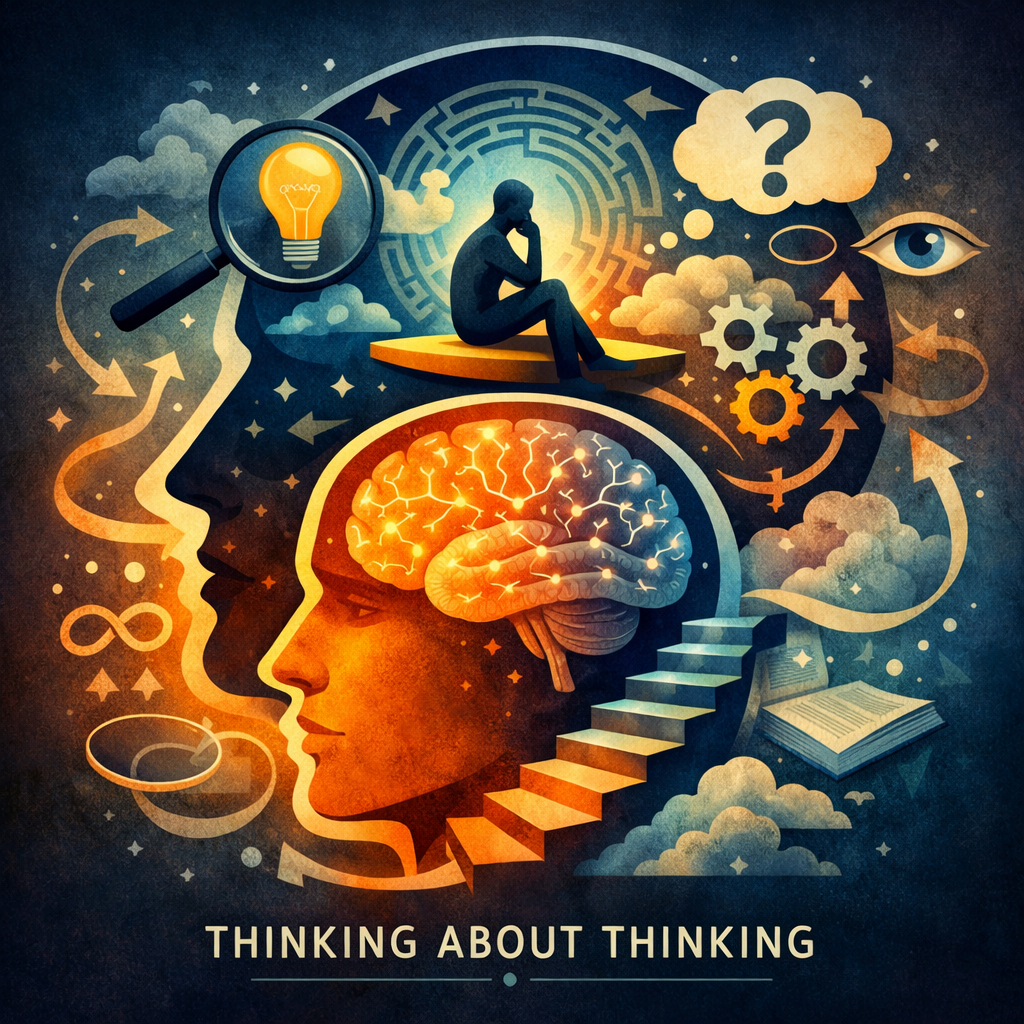
Illustration showing a human head with a brain, a person thinking, and symbolic icons representing thought process

By Stacy Hixon, MA, LPC-S, CCTP, FRTP


Metacognition is the practice of increasing awareness of how our thoughts influence our emotions, behaviors, and patterns. In simple terms, it means thinking about how we think.

Often, we move through our thoughts automatically. We may react to our emotions, treat feelings as facts, or make assumptions without pausing to weigh the evidence. Many people experience cognitive distortions, which are flawed or unhelpful thinking patterns that can affect how they see themselves, others, and situations.

When we learn to examine our thought processes, we become better able to identify cognitive distortions, challenge reactive thinking, and respond in healthier ways. This increased awareness can lead to more balanced emotions, healthier choices, and more effective behavior patterns.

Below is a directive that can help you practice Metacognition.

Situational Awareness:

    • Think of a recent situation that happened.
    • Be neutral, not inferring any interpretations.
    • What happened?
    • Where were you?
    • Who was involved?

    Automatic Thoughts:

    • What immediately went through your mind?
    • What did you tell yourself about the situation?
    • If your thoughts had a headline, what would it be?

    Emotional Reaction:

    • What feelings surfaced for you?
    • Rate the intensity of each feeling from 1 (the least intense) to 10 (the most intense)
    • Where did you feel the feelings inside of your body?

    Behavioral Response:

    Actions Taken:

    • What did you avoid doing?
    • What urges did you have?

    Thinking Patterns:

    Note any that apply:

    • All or Nothing Thinking or Black and White Thinking: Seeing things in extremes, such as good or bad, success or failure, with little room for middle ground.
    • Catastrophizing: Expecting the worst-case scenario or assuming something will be unbearable.
    • Mind Reading: Assuming you know what someone else is thinking without clear evidence.
    • Emotional Reasoning: Believing something is true because it feels true.
    • Overgeneralization: Taking one event or experience and applying it broadly to other situations.
    • Personalization: Blaming yourself for things that are not fully your responsibility.
    • Should Statements: Using rigid rules like “I should,” “I must,” or “I have to,” which can create guilt, shame, or pressure.
    • Minimizing or Discounting the Positives: Dismissing strengths, progress, compliments, or positive experiences as unimportant.

    Slow it Down:

    • What evidence do you have that supports your thoughts?
    • What evidence does not support it?
    • What might someone else see differently?
    • Am I reacting to my emotions or responding to facts?

    Core Belief Exploration:

    • What do my thoughts say about me?
    • What do my thoughts say about others?
    • What do my thoughts say about my world?

    Alternative Thought:

    • What is a more logical or helpful thought?
    • Can my feelings be valid and my thoughts be true at the same time?
    • What would I tell another person in this situation?

    Intentional Response:

    • What is the most aligned actionable behavior that align with my values?
    • What would an emotionally regulated version of me do?
    • What boundary or need is present here?

    Reflection:

    • Did my response help or hurt the situation?
    • What did I learn about my patterns?
    • What will I do differently next time?

    Practicing metacognition helps us slow down, notice our thoughts more clearly, and respond with intention rather than reacting automatically. Over time, this awareness can make it easier to challenge unhelpful thinking patterns, regulate emotions, and make choices that align with our values and goals. Metacognition is not about judging our thoughts, but about understanding them so we can create healthier patterns in how we think, feel, and behave.

    © 2026 LifeWise Counseling and Wellness, LLC. All rights reserved.

    Understanding Moral Injury: Causes and Impact

    By Stacy Hixon, MA, LPC-S, CCTP


    What Is Moral Injury and Why Does It Matter?

    A closer look at the guilt, shame, and inner conflict that can happen when life, work, or circumstances clash with your core values.

    Moral injury is psychological distress that occurs when a person does, witnesses, or feels unable to prevent actions that violate their core values or sense of right and wrong.

    Although moral injury is often discussed in connection with first responders and military veterans, it can happen in everyday life too. Many people experience it without having a name for what they are feeling.

    Where Moral Injury Comes From

    Moral injury can develop in many different situations, including:

    • Working for an agency or employer that does not support you during a difficult situation
    • Being employed by a company whose mission conflicts with your beliefs
    • Being part of an organization that does not align with your identity or values
    • Navigating family or social relationships that conflict with your worldview
    • Witnessing behaviors in others that go against what you believe is right

    At its core, moral injury develops when there is a painful clash between what you believe and what you experience, participate in, or feel powerless to change.

    How Moral Injury Shows Up

    Moral injury can affect people emotionally, mentally, and relationally. It may show up as:

    • Guilt
    • Shame
    • Anger
    • Betrayal
    • Questioning your identity or integrity

    For many people, the distress is not just about what happened. It is about what the experience means and what it seems to say about them, others, or the world around them.

    What It Can Sound Like Internally

    Moral injury often creates an intense internal struggle. Thoughts may sound like:

    • “I should have done something different, but I felt stuck.”
    • “That does not align with who I am.”
    • “Did I cross a line, or did someone else?”
    • “People do not understand what that was like.”
    • “How could I be part of something that goes against what I believe?”

    These kinds of thoughts can leave a person feeling trapped between responsibility, regret, anger, and confusion.

    The Emotional Aftermath

    When moral injury goes unaddressed, it can begin to affect everyday life. Some people notice:

    • Withdrawing from others
    • Feeling irritable or on edge
    • Emotional numbness
    • Depression
    • Feeling misunderstood or judged
    • Difficulty feeling connected in relationships

    Over time, moral injury can quietly erode a person’s sense of self, safety, and trust.

    Working Through Moral Injury

    Healing from moral injury is not about pretending something did not happen. It is about making sense of the experience and understanding why it affected you so deeply.

    That process may include:

    • Understanding the context of what happened
    • Exploring the conflict between your actions, circumstances, and values
    • Rebuilding a sense of integrity and self trust
    • Developing self compassion
    • Processing the experience with support when needed

    Because moral injury is layered, working through it can take time. For some people, professional counseling can provide a safe place to sort through the emotions, beliefs, and meaning attached to the experience.

    Final Thoughts

    Moral injury happens when we are placed in situations that conflict with who we are and what we believe.

    It does not automatically mean you are a bad person or that you failed. Sometimes it means you were faced with an impossible, painful, or deeply conflicting situation in an imperfect world.

    Naming it is often the first step toward healing.

    At its heart, healing begins when we give ourselves permission to face the conflict with honesty, compassion, and support.


    If you are struggling with guilt, shame, or inner conflict after a difficult experience, you do not have to work through it alone. LifeWise Counseling and Wellness, LLC offers supportive, trauma informed care to help you make sense of what you are carrying and move forward with clarity. Visit lifewisetx.com to learn more.

    © 2026 LifeWise Counseling and Wellness, LLC. All rights reserved. lifewisetx.com

    When You’re the Strong One: The Hidden Cost of Suppression

    By Stacy Hixon, MA, LPC-S, CCTP


    In mental health, we often see people equate being “the strong one” with suppressing their emotions and avoiding difficult experiences. When humans feel emotional pain, our instinct is to push against it and try to stop the discomfort.

    The problem is, feelings do not go away. They get pushed down inside of us.

    Over time, we keep stuffing things down until something small happens and we have a reaction that feels much bigger than the situation itself. That reaction is not just about the moment. It is the buildup of everything that was never processed.

    Most of us grew up in environments where emotions were suppressed or avoided. It is common to hear clients say, “My family just swept everything under the rug,” or “We did not talk about anything difficult.” We learn how to manage our emotions based on what we were exposed to in childhood.

    When caregivers are emotionally dysregulated due to their own suppression, those patterns are often passed down. As children, we absorb those behaviors and carry them into adulthood without realizing it.

    One of the first steps in changing this pattern is learning to identify where you feel emotions in your body. Your body is often the first indicator that something needs your attention.

    Ask yourself:

    • Where do I feel this in my body?
    • What does it feel like?

    From there, begin to explore:

    • What emotion is this?
    • What does this feeling need?
    • Why is it showing up right now?

    After identifying the emotion, it is important to regulate your nervous system before reacting. This might include slowing your breathing, grounding yourself, or taking a moment to pause.

    Once you feel more regulated, return to the emotion and consider what it needs. From there, you can create a plan of action to respond to yourself in a way that is supportive and intentional.

    © 2026 LifeWise Counseling and Wellness, LLC. All rights reserved. lifewisetx.com

    Strengthen Your Emotions: Consistent Regulation Practices

    By Stacy Hixon, MA, LPC-S, CCTP

    Emotional regulation is the ability to notice and understand your emotions. It also involves managing them so they do not control your behavior or decisions.

    It involves pausing, tolerating emotional discomfort, and responding in a thoughtful way rather than reacting impulsively.

    Most people delay thinking about implementing emotional regulation skills. They wait until they are in crisis. They often reach a stress level of 10 before considering these skills. Before they realize it though, they are back in crisis again when the next wave of stress hits.

    Emotional regulation skills work most effectively when we practice them consistently. It’s like strengthening a muscle. We have to learn to work out the brain’s ability to pause, regulate and respond rather than react. Our nervous system learns through repetition.

    When we practice emotional regulation several times a day, we learn to feel calm and emotionally stable consistently. Practicing during neutral and positive moments allows our brain to learn to process without the pressure of intense emotions. Over time, this repetition ingrains the skills as second nature. We can then use them when we’re feeling stressed, angry, anxious, or experiencing a plethora of other difficult emotions.

    Guidelines for Emotional Regulation:

    • Practice at least 3 times a day and then every time you feel stressed or difficult emotions throughout the day.
    • Spend about 5 minutes practicing in the morning when you awaken, at lunch and then before bed.
    • Be patient with the process. Emotional regulation is a skill that develops over time through repetition.
    • The goal is to make the tools automatic responses when difficult emotions arise.

    If emotional regulation is only practiced during times of emotional crisis, it may not work at all. It might not be as effective. Regular practice trains the mind and nervous system to use these strategies naturally when we are feeling dysregulated.

    Below are a list of emotional regulation skills. We suggest choosing 2 at a time to alternate practicing for a week at a time. You may switch the following week to try different ones and see which ones you like the best.

    1. Box breathing
      Inhale 4 seconds, hold 4 seconds, exhale 4 seconds, hold 4 seconds. Repeat several cycles to calm the nervous system.
    2. 5-4-3-2-1 grounding
      Identify 5 things you see, 4 you feel, 3 you hear, 2 you smell, 1 you taste.
    3. Name the emotion
      Pause and label the feeling precisely. Example: frustrated, ashamed, overwhelmed.
    4. Temperature change
      Splash cold water on the face. Alternatively, hold a cold pack to activate the dive reflex. This will lower emotional intensity.
    5. Opposite action
      Do the behavioral opposite of the emotional urge when the emotion is not justified by the situation.
    6. Cognitive reframe
      Identify the automatic thought and generate at least two alternative explanations.
    7. Progressive muscle relaxation
      Systematically tense and release muscle groups from head to toe.
    8. Body movement discharge
      Brief physical activity such as walking, stretching, or shaking out tension.
    9. Self soothing through senses
      Use sensory input such as music, scent, texture, or warmth to calm the nervous system.
    10. Urge surfing
      Observe emotional urges like waves that rise, peak, and fall without acting on them.
    11. Emotion intensity scaling
      Rate the emotion from 0 to 10 to create psychological distance and track reduction.
    12. Mindful breathing
      Focus attention only on the breath moving in and out.
    13. Thought defusion
      Observe thoughts as mental events rather than facts.
    14. Radical acceptance
      Acknowledge reality as it is without fighting it internally.
    15. Containment visualization
      Mentally place distressing thoughts into a container to revisit later.
    16. Self validation
      Acknowledge that the emotion makes sense given the situation or past experiences.
    17. Delay response
      Wait 10 to 20 minutes before responding to a triggering situation.
    18. Values check
      Ask: what action here aligns with the person I want to be.
    19. Safe person contact
      Reach out to a trusted individual for grounding conversation.
    20. Compassionate self talk
      Speak internally as one would to a respected friend who is struggling.

    © 2026 LifeWise Counseling and Wellness, LLC. All rights reserved. lifewisetx.com

    Mastering Distress Tolerance: Effective Strategies

    By Stacy Hixon, MA, LPC-S, CCTP

    We all experience stress, and stress often shows up as intense emotion. Without distress tolerance, we default to impulse. We lash out, we shut down, we avoid, we go numb. We try to escape the feeling instead of enduring it.

    Distress tolerance is different from emotional regulation. Emotional regulation is about calming the storm. Distress tolerance is about surviving the storm without making it worse.

    You can still use emotional regulation skills like breathing, grounding, and movement. Those help settle your nervous system, but distress tolerance goes further. It prepares you to function wisely when the discomfort does not immediately go away.

    Distress tolerance becomes especially important when a situation cannot be resolved quickly. For example, when your boss says they need to speak with you later and you have to sit with uncertainty. When you are navigating a breakup and want to avoid spiraling or dissociating. When you have a presentation coming up and the nerves will not disappear on command.

    Distress tolerance is learning to sit in discomfort without escalating it. It is choosing not to act on every urge. It is remaining steady enough to prevent temporary distress from turning into long term damage.

    You are not trying to eliminate the emotion. You are strengthening your ability to endure it safely.

    Right – but how?

    Distress tolerance is practiced when you are uncomfortable and choose not to react impulsively. It is not something you master in calm moments. It is built in the middle of discomfort.

    Here are practical ways to practice it:

    1. Stop trying to eliminate the feeling immediately. Tell yourself, “I do not have to solve this right now.” The goal is not instant relief. The goal is stability.
    2. Narrow your time frame. Instead of thinking about how you will survive the week, focus on surviving the next ten minutes. Distress becomes manageable when you reduce the window.
    3. Delay decisions. When you are activated, postpone major conversations, life changes, or emotional reactions. Waiting is a skill. Often, the urge passes if you give it time.
    4. Anchor to your body. Sit upright. Plant your feet on the ground. Slow your breathing. You may not feel calm, but you are signaling to your nervous system that you are safe enough.
    5. Use healthy distractions intentionally. Take a walk. Clean something. Call a grounded friend. Watch something neutral. This is not avoidance. It is giving your nervous system space to settle.
    6. Practice acceptance language. Replace “This should not be happening” with “I do not like this, but it is happening.” Fighting reality increases suffering. Acceptance reduces resistance.
    7. Track the wave. Notice that emotions rise, peak, and fall. When you sit with them instead of reacting, you build confidence that you can survive discomfort.

    Distress tolerance is not about liking pain. It is about choosing not to create more pain while you are already hurting.

    You are strengthening your ability to stay steady under pressure. That is a skill that changes relationships, decision making, and long term stability.

    © 2026 LifeWise Counseling and Wellness, LLC. All rights reserved. lifewisetx.com

    Dealing with Hurt: A Deeper Look at Perspectives

    By Stacy Hixon, MA, LPC-S, CCTP

    It is difficult, when someone hurts you, not to see things only from your side of the pain. When we are hurting, our mind naturally centers our own experience. However, it is important to remember that there is another person on the other side of that hurt who may also be struggling and may not be considering your perspective either.

    Most people do not wake up in the morning intending to hurt someone else. While there are certainly exceptions, the majority of people act from their own emotions, fears, and unresolved experiences rather than a conscious desire to cause harm. When someone does intentionally try to hurt others, that is a sign that they need to take a long and honest look at themselves.


    How Perspective Shapes Reality

    I often tell my clients that five people can watch the same sunset and describe five completely different experiences. One may notice the colors, another the quiet, another the memory it triggers, and someone else may barely notice it at all.

    Are any of them wrong? No. They are simply experiencing the same moment through different lenses.

    The writer Anais Nin captured this idea perfectly:

    “We do not see things as they are; we see them as we are.”
    Anais Nin

    Our view of the world is shaped by our life experiences. Even children raised in the same family grow up with different perceptions because their parents are at different stages of maturity, stress, and life circumstances with each child.

    Every experience we have shapes who we are, how we interpret events, and how we respond to others. Because our experiences are unique, our perspectives will naturally differ from those of the people around us.


    A Lesson That Stayed With Me

    When I was in my early twenties, I worked for a woman who was older at the time, though she was actually the age I am now. She once told me something that stayed with me for the rest of my life.

    She said that we often do not understand why people behave the way they do because we do not know what they have been through.

    That single sentence changed how I began to view conflict and behavior. When we do not know someone’s story, it is easy to assume their actions are about us when, in reality, they may be reacting to wounds we cannot see.


    What I Learned About Hurt

    When I was younger, I often personalized hurt. If someone said or did something that upset me, my immediate thought was that they did it on purpose.

    Over time, through both my personal healing journey and my professional experience, I learned something different. Most people are not trying to hurt others. More often, they hurt others because they feel threatened, insecure, or emotionally overwhelmed.

    When someone has not processed their own pain, they tend to react rather than reflect. Instead of pausing to understand their feelings, they lash out. When that happens, relationships can quickly become a cycle of reaction and retaliation.

    What begins as hurt can easily become a back and forth exchange of pain.


    When You Feel Hurt, Pause and Reflect

    The next time you feel hurt, pause for a moment and ask yourself a few questions.

    • Why am I hurting right now?
    • What specifically about this situation affected me?
    • Is this truly about me, or could the other person be struggling with something within themselves?
    • Could I simply be a casualty in their internal battle?

    Many times, the pain we experience comes from being caught in someone else’s unresolved struggle.

    Is that fair? No. It is not.

    People often bleed on others because they have not healed their own wounds. In many ways, that reality is one of the reasons counseling exists.


    Protecting Yourself While Staying Open to Perspective

    Looking at situations from different perspectives does not mean tolerating harmful behavior. Sometimes the healthiest thing we can do is step away from a relationship or establish firm boundaries.

    Healthy responses may include:

    • Setting clear emotional boundaries (A boundary is where the disrespect ends, it’s not a demand for the other person to obey.)
    • Limiting contact with someone who repeatedly causes harm
    • Protecting your mental and emotional well being
    • Recognizing that someone may not be capable of seeing another perspective

    It is completely acceptable to prioritize your own wellbeing.

    At the same time, it can be valuable to remember that our view, while valid, is not the only view that exists. Human emotions and behavior are complex, nuanced, and deeply shaped by personal history.


    Questions for Reflection and Conversation

    Consider these questions and feel free to share your thoughts:

    • Have you ever realized later that someone’s behavior was more about their struggles than about you?
    • Has your perspective on conflict changed as you have gained life experience?
    • What helps you pause and reflect before reacting when you feel hurt?

    Your experiences and insights may help someone else see their situation in a new way.


    Key Takeaways

    • People often react from their own wounds rather than from a desire to hurt others
    • Every person views the world through the lens of their own life experiences
    • Hurt in relationships often comes from emotional reactivity and unprocessed pain
    • Reflection can help us respond thoughtfully rather than react emotionally
    • Healthy boundaries are necessary when someone repeatedly causes harm

    © 2026 LifeWise Counseling and Wellness, LLC. All rights reserved. lifewisetx.com

    Understanding Stress: How It Affects You

    By Stacy Hixon, MA, LPC-S, CCTP

    Stress is something every human can relate to. It does not discriminate as it affects everyone at some point.

    So what is stress? Stress is an activation response in your mind and body. It is like a switch that turns on when you are faced with a challenge. That challenge can be real, or it can be perceived. In other words, your brain reacts to what it believes is a threat, even if there is no actual danger present.

    When we are under stress, our nervous system shifts into survival mode. Your body reacts as if you are in danger, even if the “threat” is just a deadline, financial pressure, or a difficult conversation. Your heart may beat faster, your breathing may become shallow or rapid, your muscles tighten and your thoughts become more reactive and less logical. The part of your brain responsible for reasoning and decision making quiets down, while the survival part becomes louder.

    When we are stressed, what we need is emotional regulation. Emotional regulation is the ability to manage and respond to your emotions in a balanced and controlled way instead of reacting impulsively. It does not mean ignoring your emotions. It means slowing down enough to respond thoughtfully rather than react automatically.

    There are several practical ways to emotionally regulate.

    • Box breathing is one simple technique. Inhale through your nose for four seconds. Hold your breath for four seconds. Exhale through your mouth for four seconds. Hold again for four seconds. Repeat this cycle several times. This helps signal safety to your nervous system.
    • Grounding techniques are also effective. You can drink something ice cold or hold an ice cube in your hand. You can orient yourself to your environment by naming things you see, hear, feel, and smell. You can splash cold water on your face or run cold water over your hands. These strategies help bring your body back to the present moment.
    • Movement is another powerful tool. Going for a short walk, stretching, jumping in place, or physically shaking out tension can help release stress chemicals that build up in the body.
    • Decatastrophizing is asking yourself, “What is actually happening right now?” This helps separate facts from worst case thinking and brings your mind back to reality.
    • Email yourself f you feel the urge to say something you may regret, write an email expressing exactly how you feel and send it to yourself instead. Giving your nervous system time to settle before engaging can prevent unnecessary conflict.
    • Music and vibration can also help regulate the body. Listening to music or using a vibrating massager on your neck and shoulders can help release physical tension.

    If possible, avoid engaging in difficult conversations while you are dysregulated. If you must engage, distress tolerance skills become essential, and that is something we can explore next.

    © 2026 LifeWise Counseling and Wellness, LLC. All rights reserved. lifewisetx.com

    When Psychology Becomes a Buzzword

    By Stacy Hixon, MA, LPC-S, CCTP

    Enough!

    Mental health diagnoses are not buzzwords. They are not trends. They are not there to make your story sound more dramatic.

    When you casually say you are “so OCD” because you like your house clean, you are not being cute. You are trivializing a disorder that can trap someone in hours of compulsions they desperately wish they did not have.

    When you call someone a narcissist because they were selfish or hurt your feelings, you are not being insightful. You are flattening a complex personality disorder into a convenient insult.

    When you say you are “depressed” because you had a bad day, you are not increasing awareness. You are minimizing an illness that has taken lives.

    When you joke about killing yourself over an inconvenience, you are not being funny. You are mocking people who fight intrusive thoughts about death every single day.

    Stop!

    Do You Understand What You Are Dismissing?

    Anxiety disorders can mean your body never leaves survival mode. Your heart races, , your chest tightens, your brain scans for danger that is not there. Sleep is fractured and peace is foreign.

    Major depression can mean your body feels weighted. Your mind slows, joy disappears, hygiene feels overwhelming and living feels optional.

    Obsessive Compulsive Disorder can mean checking the stove fifty times because your brain refuses to let you rest until you do.

    Bipolar disorder can mean episodes that dismantle relationships, finances, reputations.

    ADHD can mean knowing you are intelligent and capable while repeatedly failing to execute because your brain processes the world differently.

    Suicidal ideation can mean negotiating with your own thoughts just to stay alive.

    This is not trendy language. This is suffering!

    Words Either Honor Reality or Distort It

    When you turn diagnoses into slang, you dilute their meaning. When everything is “anxiety” or “trauma” or “narcissism,” the words lose their clinical weight.

    And when those words lose weight, the people carrying those diagnoses lose validation.

    You do not get to borrow the intensity of a disorder for emphasis while ignoring the reality of people who live with it.

    Mental health awareness was meant to reduce stigma, not create a culture where serious diagnoses are tossed around like hashtags.

    If you care about mental health, act like it.

    Use language responsibly, learn the difference between discomfort and disorder and stop glamorizing what destroys people.

    Mental health is not a trend, it is not entertainment, it is not a brand, it is someone’s lived experience and struggle.

    If you are genuinely concerned about your own symptoms, seek proper evaluation from a licensed professional. Let’s take a look at the actual definitions of these mental health diagnoses below.

    Brief Clinical Definitions

    Generalized Anxiety Disorder
    A condition marked by persistent, excessive worry occurring more days than not for at least six months, accompanied by physical symptoms such as restlessness, muscle tension, irritability, and sleep disturbance.

    Major Depressive Disorder
    A mood disorder involving at least two weeks of persistent low mood or loss of interest, along with cognitive, emotional, and physical symptoms that impair daily functioning.

    Obsessive Compulsive Disorder
    A disorder characterized by intrusive, unwanted thoughts and repetitive behaviors or mental rituals performed to reduce anxiety or prevent feared outcomes.

    Obsessive Compulsive Personality Disorder
    A personality pattern defined by rigid perfectionism, control, and preoccupation with order at the expense of flexibility and relationships.

    Bipolar Disorder
    A mood disorder involving cyclical episodes of depression and periods of mania or hypomania marked by elevated mood, increased energy, decreased need for sleep, and impulsivity.

    Narcissistic Personality Disorder
    A pervasive pattern of grandiosity, need for admiration, and lack of empathy that significantly impairs relationships and functioning.

    Antisocial Personality Disorder
    A chronic pattern of disregard for and violation of the rights of others, often including deceitfulness, impulsivity, and lack of remorse.

    Attention Deficit Hyperactivity Disorder
    A neurodevelopmental disorder affecting executive functioning, attention regulation, impulse control, and organization across multiple settings.

    Suicidal Ideation
    Recurrent thoughts about wanting to die or harm oneself, ranging from passive wishes not to exist to active planning.

    Post Traumatic Stress Disorder
    A trauma related disorder involving intrusive memories, avoidance, negative changes in mood or thinking, and heightened arousal following exposure to a traumatic event.

    If you or someone you know is struggling, please contact us at lifewise@lifewisetx.com

    © 2026 LifeWise Counseling and Wellness, LLC. All rights reserved. lifewisetx.com